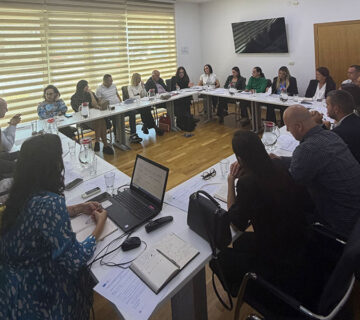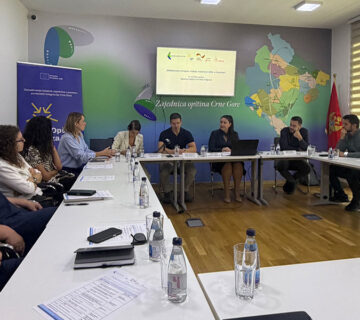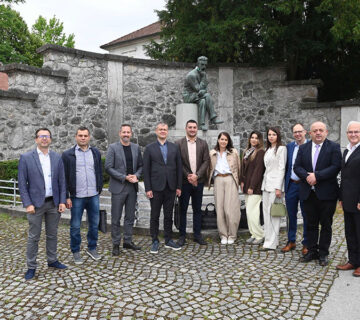


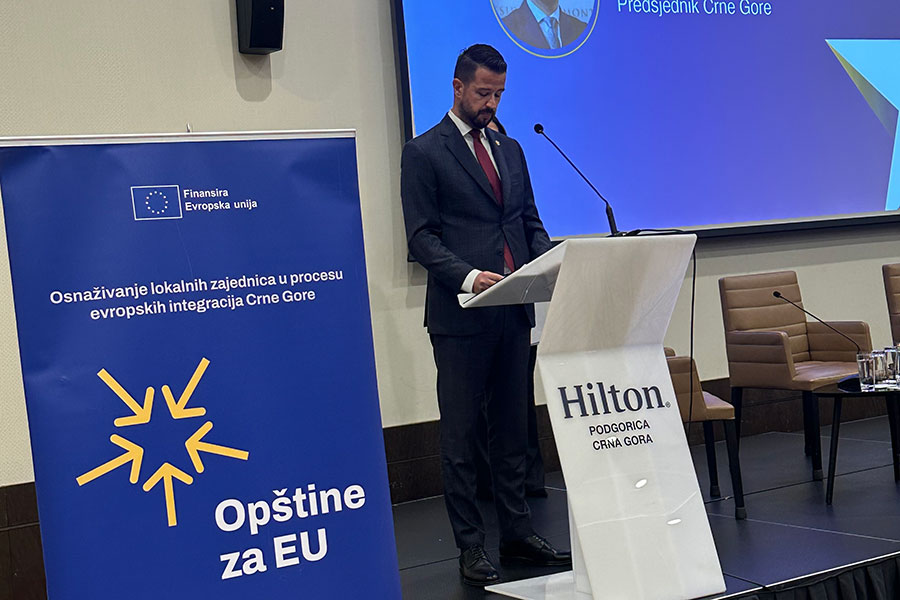
Local government reform must bring tangible changes that citizens can feel in their everyday lives, while its successful implementation requires strong municipalities, sustainable partnership with state institutions and joint efforts on Montenegro’s path towards the European Union. This was the key message from the conference “Local Government Reform on the Path to the EU”, organised by the Union of Municipalities of Montenegro to mark 54 years of its work and existence.
The President of Montenegro, Jakov Milatović, pointed out that for more than half a century, the Union of Municipalities has served as an important link between local communities and the state level – “a space for discussing how to make our municipalities stronger, more accountable and closer to citizens”.
Citizens experience the state most directly at the local level – through the quality of services, infrastructure, environmental protection, employment opportunities and the conditions in which they raise their families, Milatović said. Therefore, according to the President of Montenegro, local government reform is not merely an administrative issue. It is about what kind of Montenegro we want to build and what kind of Montenegro we want to bring into the European Union.
“Our goal is clear: Montenegro as the 28th member of the European Union by 2028. However, European integration is not merely about dates and closing negotiation chapters. Its true value must be visible in the everyday lives of citizens, in every municipality, every town and every village,” Milatović said.
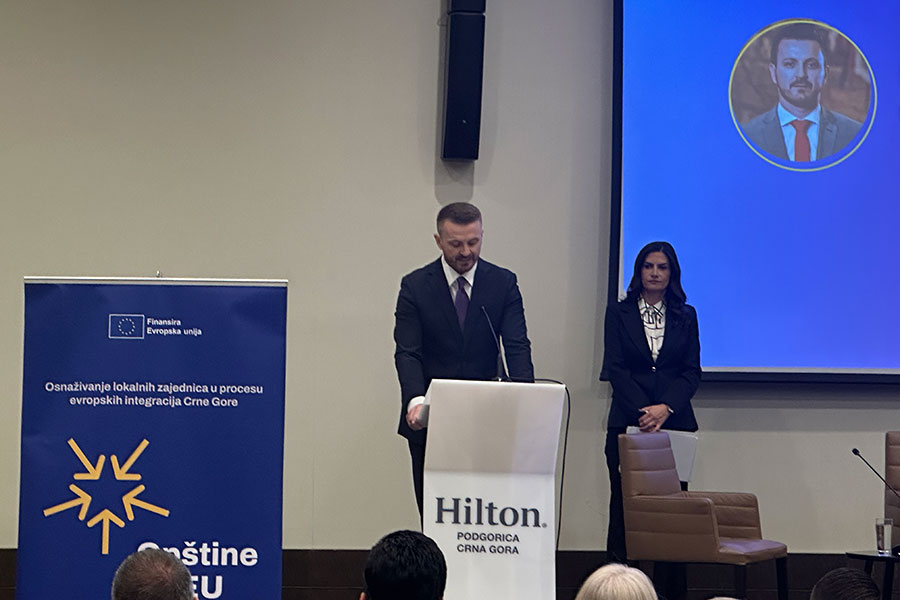
The Minister of Public Administration, Marash Dukaj, agreed that local government reform is a shared responsibility of both the national and local levels of government.
“Today, we are discussing local government reform. This is not the reform of a single ministry, nor is it solely a reform of municipalities – it is a reform of the state. That is why we have made it one of the key priorities of the Ministry of Public Administration, fully aware that change will come neither quickly nor easily. What requires the most time and the greatest courage is changing the way we think and work. We can successfully implement this reform only together, with a clear objective and moving in the same direction,” Dukaj said.
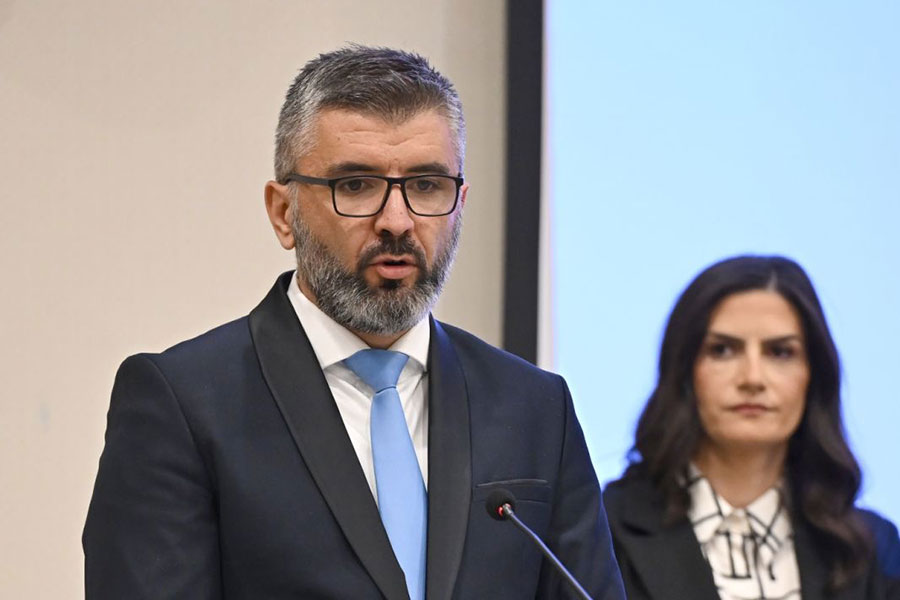
The President of the Governing Board of the Union of Municipalities and President of the Municipality of Žabljak, Radoš Žugić, stressed that the Union is a platform for developing common positions on issues of importance to local government and for building strong partnerships with state institutions. He particularly emphasised the importance of decentralisation.
“Strong local government is not a competitor to the state – it is one of its pillars. Whenever possible, decisions should be made as close to citizens as possible, because local government has the best understanding of the needs of its population and the specific characteristics of each area,” Žugić said.
Žugić noted that the role of municipalities will become increasingly important in the process of accession to the European Union, given that many European policies and standards are implemented in practice precisely at the local level – through infrastructure, environmental protection, energy efficiency, digitalisation, municipal services and the strengthening of local economies.
“Municipalities should therefore not merely be beneficiaries of European funds, but active drivers of the European integration process. Our task is to become better prepared, more efficient and more capable of making full use of the opportunities that membership in the European Union will bring,” Žugić said.
“A European Montenegro is built both in Podgorica and in each of our towns. European standards become a reality when citizens experience them in their own streets, neighbourhoods and municipalities. That is why we need even more dialogue, cooperation and trust between the state and local governments. A strong state and strong municipalities are not competing objectives. On the contrary – only strong municipalities can provide the foundation for a strong, modern and European Montenegro,” Žugić concluded.
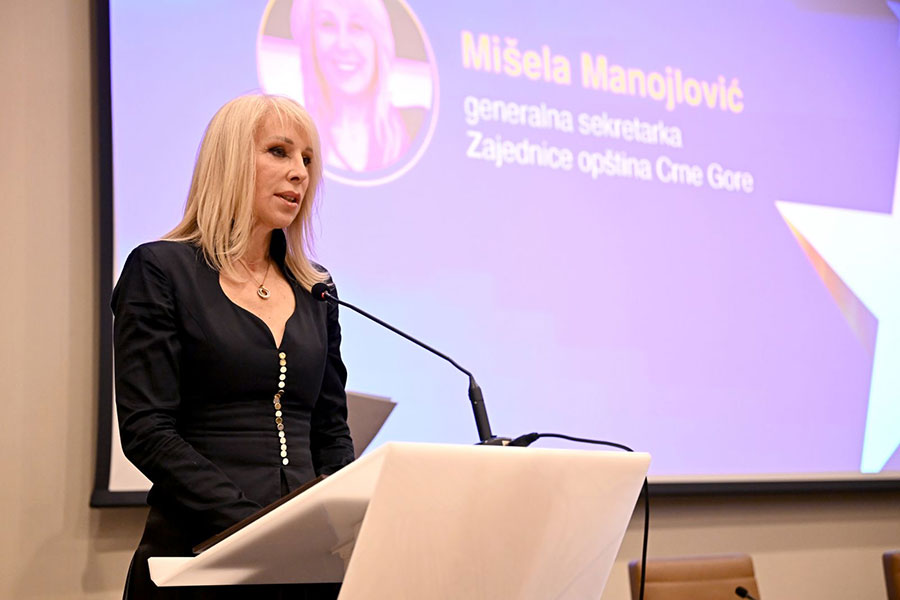
The Secretary General of the Union of Municipalities, Mišela Manojlović, stressed that the institution’s 54 years of continuous work demonstrate the value of joint action by municipalities and the importance of representing their shared interests.
“This proves that an institution can endure when it is built upon the common interests of municipalities. Over more than five decades, this model has demonstrated that common interest is not merely a phrase, but a method – a method through which professionalism, knowledge and expertise lead to better living conditions in local communities. The Union of Municipalities was created out of necessity and has endured for a reason. And that reason is simple: an individual municipality has a voice. Together within the Union, municipalities have both a voice and strength,” Manojlović said.
She particularly emphasised that the Union’s greatest value lies in the ability of municipal representatives to work together on issues that matter to citizens, despite their different political affiliations.
“Mayors and presidents of municipal assemblies who govern the Union come from different political parties. And this is precisely where its greatest value lies, because when they sit around the same table, politics steps aside. What remains are needs and citizens. What remains is the work to be done and the search for ways to get it done, because politics loses its importance where real life begins and citizens knock on the door with needs that must be addressed,” Manojlović said.
She recalled that for decades municipalities have acted jointly before state authorities and international organisations, as partners and counterparts offering concrete solutions.
“That is why our strategy is clear. We want to achieve the same unity with the state authorities, because we share the same interests – to bring together knowledge and expertise as Montenegro’s most valuable resource and, by joining forces, accelerate Montenegro’s European path. It is time for citizens to experience a better quality of life and to feel proud to belong to a country that is moving forward. A country that listens to them and serves them,” Manojlović said.
The Secretary General also highlighted the Union of Municipalities’ pride in its substantive contribution to Montenegro’s European path, through strengthening the legal framework, reinforcing the rule of law and enhancing municipal capacities. She thanked everyone who has contributed to building the institution over the years, as well as those who continue its work today.
The conference continued with panel discussions on human resource management in municipalities: between the legal framework and demographic realities, and local government financing: between responsibilities and available resources.
The conference is funded by the European Union through the “Municipalities for EU” project.