

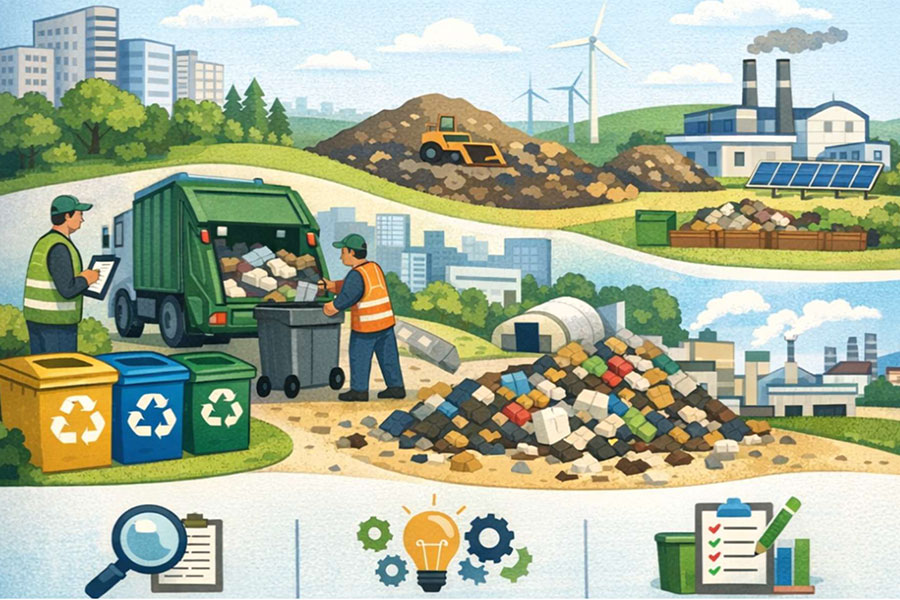
The Practical Guide for the Preparation of Local Plans for the Management of Municipal and Non-Hazardous Construction Waste has been developed following an analysis of the applicable Law on Waste Management, the National Waste Management Plan for the period 2025–2029, and the Waste Management Strategy until 2030, as the key regulatory frameworks, in order to facilitate a clearer and more understandable approach to drafting these documents.
Article 30 of the Law on Waste Management stipulates the obligation of local self-government units to prepare Local Plans for the Management of Municipal and Non-Hazardous Construction Waste for the same period covered by the National Plan, i.e. until 2029.
The National Waste Management Plan for the period 2025–2029 entered into force upon its publication in the Official Gazette of Montenegro No. 025/26 of 27 February 2026. This is important to highlight in light of the obligations of local self-government units, in accordance with the Law on Waste Management (Article 117, paragraph 2), to adopt their local plans within nine months.
The Practical Guide is designed to contribute to the efficiency of the preparation process by providing practical guidance based on examples of good practice.
Taking into account the challenges faced by local self-government units in establishing a sustainable waste management system, reporting obligations, the ambitious targets set in the National Plan, as well as the required infrastructure and equipment, the purpose of this Guide is to support a realistic assessment of the current situation, identification of key issues, and the definition of a roadmap for fulfilling the core objectives of local plans, as a prerequisite for their visible and measurable implementation.
In line with the legal requirement that local plans contain 14 elements to be elaborated, this Guide addresses each of them individually, supported by examples that facilitate their preparation and implementation.
Furthermore, the Guide addresses the identification of target groups, potential partners, regional cooperation opportunities, communication channels with citizens, and risk assessment as a preventive mechanism for potential challenges in the implementation of local plans.
Taking into account the specificities of local communities, opportunities for improvement, and the potential for innovative practices, the Practical Guide aims to inspire applicable activities based on realistic and achievable projections.
To ensure a comprehensive approach, the Guide also identifies responsibilities for supporting the implementation of local plans, reporting to competent institutions, and accompanying public awareness campaigns targeting citizens.
The Guide further recommends establishing continuous communication with citizens by informing them about activities in the field of waste management, assessing their satisfaction with existing waste management infrastructure and organization, and enabling them to provide suggestions for improvement.
Aleksandar Perović, Author