

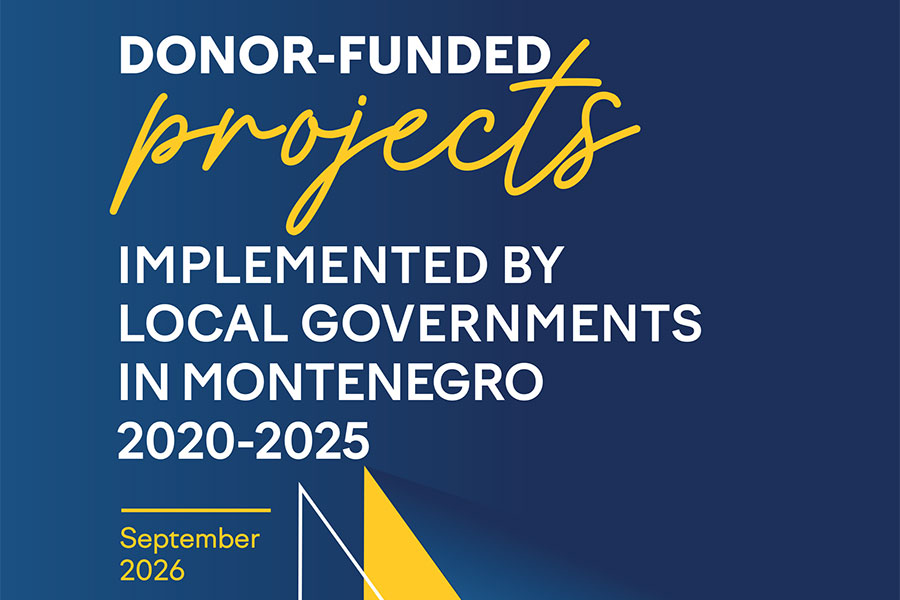
European Union funding supported 87.2% of the projects covered by the first comprehensive report on donor support to local governments in Montenegro, prepared under the project “Municipalities for EU – Empowering Local Communities in Montenegro’s EU Integration Process.”
Between 2020 and 2025, the implementation of 141 donor-funded projects began in Montenegrin municipalities, with a combined allocated project budget of €31.69 million. These findings are presented in the publication “Donor-Funded Projects of Local Governments in Montenegro 2020–2025,” which provides the first consolidated overview of the scale, structure and geographical distribution of donor support at the local level.
The report was prepared under the project “Municipalities for EU – Empowering Local Communities in Montenegro’s EU Integration Process,” funded by the European Union.
European Union Remains the Largest Donor
Of the 141 projects identified, 123 were financed through European Union funding, with allocated project budgets totalling €29.65 million. This represents 93.5% of the total value of project budgets covered by the analysis. The remaining 18 projects were supported by bilateral donors and other international partners.
Interreg IPA cross-border cooperation programmes account for the largest number of projects among EU funding programmes, supporting 51 projects with a combined allocated budget of €10.25 million.
Nikšić Leads in Both the Number of Projects and Allocated Funding
The analysis covers 25 local government units. Nikšić reported the highest number of projects (14), followed by Kotor (12) and Žabljak (11), while Ulcinj, Budva and Bijelo Polje each reported nine projects.
Nikšić also ranks first in terms of allocated project budgets, with €11.06 million. The largest share relates to a wastewater management project, for which a budget of €10 million was allocated.
Environmental protection accounts for the largest number of recorded projects (50), while infrastructure and public services received the highest total allocation of funding. Other projects cover economic development, social services, culture, cultural heritage protection and additional local development priorities.
As of 31 December 2025, 69 projects had been completed, while 72 were still under implementation.
Strengthening Municipal Capacities to Access EU Funds
In the foreword to the publication, Montenegro’s Minister of Public Administration emphasises the increasingly important role that local governments will play in accessing European funds and implementing development projects.
“In the coming years, municipalities will be among the largest beneficiaries of European funds. Every well-prepared European project means a new school, a new road, improved water supply or sewerage infrastructure, more efficient municipal services and a better quality of life for citizens.”
The report also highlights the need to further strengthen the capacities of local governments, particularly smaller municipalities, to develop high-quality project proposals, attract funding and manage donor-funded projects effectively.
By consolidating data into a single database, the publication provides a foundation for improved strategic planning, better coordination of donor support, monitoring of results and greater transparency in informing the public about investments in local development.
The full report, “Donor-Funded Projects of Local Governments in Montenegro 2020–2025,” is available [download link].